Soil, seeds, pests, and everything the garden centers skip.
Twenty-nine chapters on how to fill a garden with free plants, feed the soil for nothing, and beat the pests without buying a single bottle. Garden centers are retail businesses, and a place that sells things has no way to make a living telling you the best fertilizer on earth is last fall's leaf pile. That information is not hidden. It is just not stocked.
This is a working handbook, not a coffee table book.
There are no photographs of gardens you will never have in here and no chapters about garden design philosophy. What you cannot get easily is the reason your seedlings come up pale and floppy, or why the marigold border did not stop anything, or how much water is actually enough. That is what I have written down.
Your seedlings come up long, pale, and floppy
Legginess is a light problem, not a water problem and not a feeding problem. A windowsill in March is dimmer than it looks. A thirty dollar LED shop light two to four inches above the leaves ends it for good.
Chapter 7
You water every day and it still wilts by noon
A little water every day trains roots to stay in the top inch, where they cook in July. Soak six inches down, then leave it alone until the top two inches are dry. A finger to the second knuckle beats any meter sold in a store.
Chapter 16
Your marigold border did not stop anything
A marigold does not create a force field. Flowers work by feeding the predators that do the actual killing — and hoverflies have short mouthparts, so alyssum feeds them and a zinnia does not. You are not building a wall. You are hiring staff.
Chapter 19
Spring costs you a hundred dollars in six-packs
There is a two dollar tomato in a bowl in most kitchens in America, and inside it are between one hundred and three hundred viable seeds. The six pack is the worst deal in the garden, and the chapter shows the arithmetic.
Chapters 6 & 8
Your beds bake and the weeds keep coming
Bare soil is the single most common mistake I see in home gardens, and it is free to fix. Two to three inches of mulch cuts watering roughly in half, stops most weeds before they start, and feeds the soil as it breaks down.
Chapter 4
You bought the spray before you found the bug
Most of what gets sprayed in home gardens is sprayed at damage that was already done, by an insect that had already left, on a plant that would have recovered. Identify the damage first. Half the time the answer is to do nothing.
Chapter 18
The quick-start road map
Ninety percent of what goes wrong traces back to three things.
All three can be fixed in a single Saturday for under twenty dollars. They are printed in the front of the book, before the first chapter, because if you do nothing else in it, do these.
Fix One
Find out what your soil actually is
A straight-sided jar, one third soil from six inches down, water to an inch from the top, a drop of dish soap. Shake it hard for two minutes and leave it overnight. By morning it has settled into sand, silt, clay, and floating organic matter, and the proportions tell you what you are working with.
Twenty minutes· costs nothing
Fix Two
Put down mulch
Two to three inches on every bed, pulled back an inch from the stems. Straw, shredded leaves, grass clippings dried for a day first, wood chips on the paths. There is nothing else in gardening that does four useful jobs at once for no money.
An hour or two· free, or about $8 a bed
Fix Three
Water deep and water rarely
For most beds in most summers, a deep soak twice a week. Push a finger into the soil to the second knuckle: damp means wait, dry means water. This one is purely a change in habit, and it is the change that fixes the most plants.
No time· costs nothing
Soil you understand, covered with mulch, watered deeply. That is the whole foundation. Everything else in the book — the propagation, the pest work, the season extension — is built on top of it, and none of it works well without it.
How every chapter is built
The same four moves, twenty-nine times.
Read it in whatever order suits you. Fix the problem that is bothering you most, then come back for the rest. Do not try to do all of it in one season — the people with the good gardens are not the ones who did everything at once. They are the ones who did one thing right every year for ten years.
01
What the trouble is
And what we are going to do about it, said plainly, before a single material is mentioned.
02
The method, walked in the row
The way one gardener walks another through it standing in the bed, not read out as a list.
03
The price, in dollars
Where a method costs real money, the number is there — and where the fifteen dollar solution beats the free one, it says so.
04
The short version
Five or six lines at the end you can read on their own, when you are in a hurry or coming back to a chapter.
Contents
Twenty-nine chapters, grouped the way a season runs.
Soil first, because soil decides most of your results and gets the least attention. Then seeds and free plants, which is where the real money is saved. Then the season, water, pests, mistakes, harvest, and the year laid out month by month. Tap a part to see its chapters.
Part I · Soil5 chapters
Start With The Dirt: The Twenty Minute Test That Tells You Everything
Compost Without A Bin, A Tumbler, Or A Thermometer
Sheet Mulching: Building A Bed On Top Of Grass Without Digging
Feeding Soil For Free: Leaves, Grounds, Shells, And What Actually Works
Raised Beds: When They Help And When They Are A Four Hundred Dollar Mistake
Part II · Seeds & Free Plants6 chapters
Why The Four Dollar Six Pack Is The Worst Deal In The Garden
Starting Seeds On A Windowsill For Almost Nothing
One Tomato, Forty Plants: Growing From Grocery Store Produce
Cuttings: One Plant Into Twenty, No Rooting Hormone Required
Free Plants Every September: Division, Layering, And The Curb
Saving Your Own Seed: The Garden That Never Needs A Catalog
Part III · The Season4 chapters
Frost Dates And The Only Calendar That Matters
Depth, Spacing, And The Three Things Everyone Gets Wrong
Six Crops You Will Regret Not Planting This Fall
The Cold Frame: Two More Months For Under Twenty Dollars
Part IV · Water & Feeding2 chapters
Watering Deep, Watering Rare, Watering At The Roots
Fertilizer: What You Need, What Is A Con, And What To Make
Part V · Pests & Disease6 chapters
Know The Damage Before You Reach For Anything
Five Flowers That Drive Bugs Off, And One To Skip
The Homemade Sprays That Actually Work
Slugs, Squash Bugs, Beetles, And Aphids: The Four That Ruin Gardens
Deer, Rabbits, Squirrels, And Birds
Blight, Mildew, And Rot: Stopping Disease Before It Starts
Part VI · Mistakes2 chapters
Four Things I Planted That I Wish I Never Had
The Twelve Mistakes That Kill A First Garden
Part VII · Harvest2 chapters
Picking At The Right Moment
Keeping The Harvest Without A Freezer Full Of Mush
Part VIII · The Year2 chapters
The Month By Month Garden Year
The Tools Worth Buying And The Ones To Walk Past
Appendix · The Back PagesReference
The Crop Sheet — depth, spacing, days to maturity, and when to start, for everything worth growing
The Free Plant Ledger — what you propagated, what took, and what to change next season
The Quick-Start Road Map — the three fixes, printed before the first chapter
Real 2026 prices wherever a method costs money, and the places to just buy the product
Read a page
Chapter 8 · One Tomato, Forty Plants: Growing From Grocery Store Produce
There is a two dollar tomato sitting in a bowl in most kitchens in America, and inside it are somewhere between one hundred and three hundred viable seeds. That is the entire premise of this chapter. A great deal of what passes through a grocery store is not just food, it is planting stock, and the store has no idea it is selling it to you that way.
I want to be precise about what works and what does not, because this subject attracts a lot of cheerful nonsense online.
Tomatoes: The Best One
Any tomato with seeds will give you seedlings. Grocery tomatoes are almost always F1 hybrids, which means the plants will not be identical to the parent, and that is fine. You will get tomatoes. They may be a little different in size or timing. Some will be better than the parent. This is how a lot of good varieties were found in the first place.
The method that gives you the highest germination is fermentation, which sounds fussy and takes four days of doing nothing.
Squeeze the seeds and surrounding gel into a jar. Add an inch of water.
Leave it on the counter for three to four days at room temperature. It will grow a film of white mold and smell unpleasant. That is correct.
The fermenting breaks down the gel sac around each seed, which contains a germination inhibitor, and it also kills several seed-borne diseases.
Add water, stir, and pour off the floating pulp and any floating seeds, which are not viable. Good seeds sink.
Rinse in a fine sieve, spread on a plate or coffee filter, and dry for a week somewhere with air movement. Not on paper towel, which they stick to.
Dried tomato seed keeps four to six years. One good tomato, and you have more plants than your neighborhood can use. That is where the forty comes from, and forty is conservative.
What regrows, and what is a science project
Green onions, garlic, ginger, sweet potato slips
A genuine, permanent supply
Dry beans, peas, popcorn from the bulk aisle
The cheapest seed on earth
Celery butts, lettuce cores, cabbage cores
A few pale leaves, then rot
Carrot tops
Foliage forever, never another carrot
…continues for four more pages, and twenty-eight more chapters.
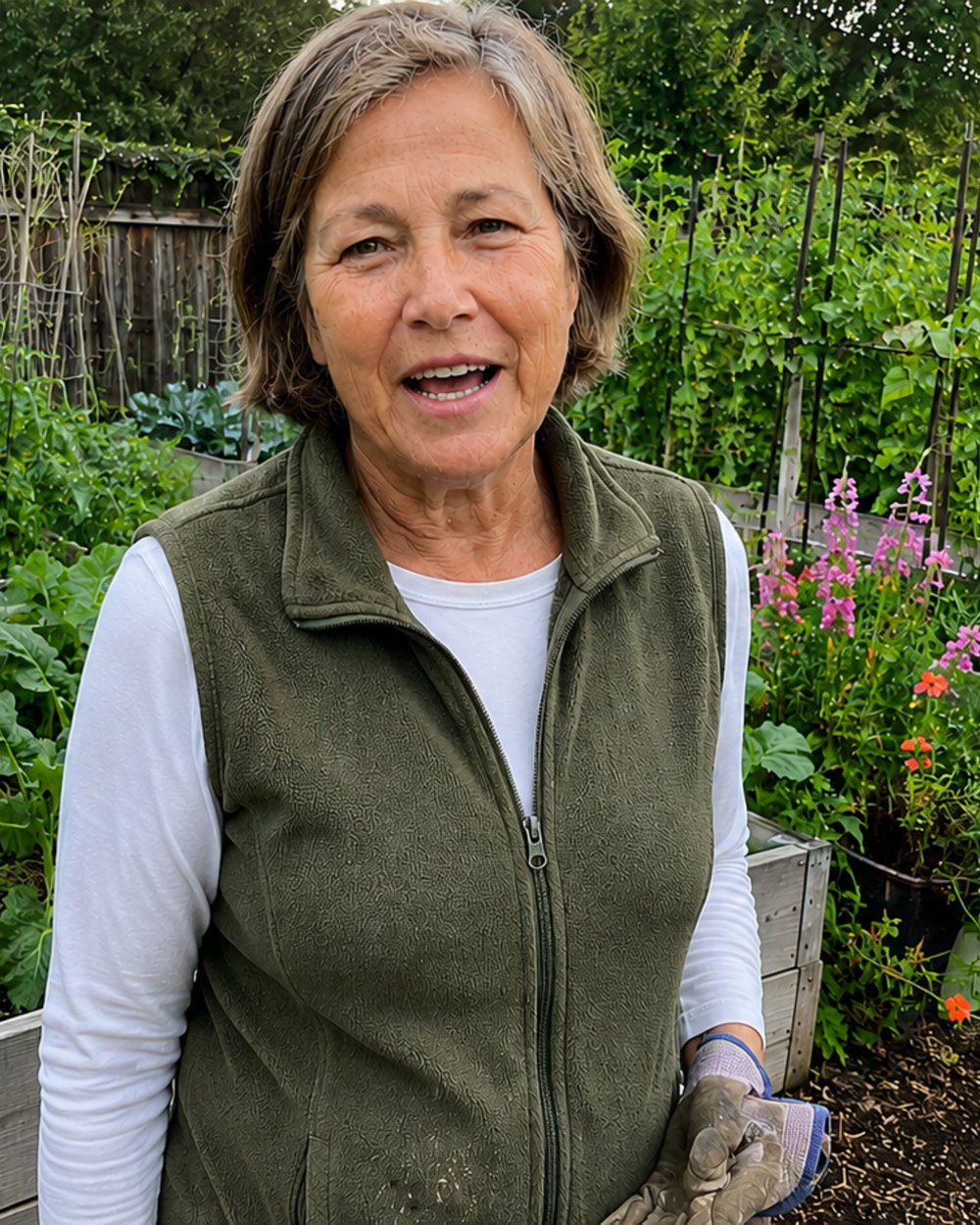
Rose Thornbury, in the beds she has grown in for thirty years.
Who is writing
My name is Rose.
I have been growing food and flowers in the same backyard for a long time now, and for the first several years of that I did almost everything the expensive way.
I bought transplants when I should have bought seed. I bought bagged soil when I had a leaf pile twenty feet away. I bought sprays for pests I had not identified, on plants that were not actually being eaten, at a garden center staffed by a nice teenager who had been told to point at the shelf.
Nobody was lying to me. That is the part worth understanding. A place that sells things has no way to make a living telling you that the plant you are about to buy for fourteen dollars will root from a cutting off your neighbor's shrub in six weeks, for nothing.
So that is what this book is. The soil part, the seed part, the pest part, and all the parts in between that the shelf skips. Where a method costs real money, I say how much. Where a thing that gets repeated all over the internet does not actually work, I say that too — even when it is a thing I would like to be true.
A garden gets better because a gardener gets better, and a gardener gets better mostly by paying attention.
Before you buy it
What this book will not do.
It will not show you photographs of gardens you will never have. The pictures in it are there when a picture explains something a sentence cannot.
It will not pretend free always wins. There are a few places where the fifteen dollar solution beats the free one, and pretending otherwise would waste your season.
It will not fix everything in one summer. Pick two or three things from the first parts, do them properly, and see what your beds look like next year.
It will not give you a growing zone you do not have. It gives you your frost dates and the calendar that follows from them, which is the part that actually travels.
The digital first edition
The Backyard Grower's Handbook
Soil, seeds, pests, and everything the garden centers skip.
29 chapters across eight parts, 160 illustrated pages
Real 2026 prices wherever a method costs money — and the places to just buy the product
The Crop Sheet — depth, spacing, days to maturity, and when to start
The Free Plant Ledger — what you propagated, what took, what to change
A short version at the end of every chapter, for the second read
Lifetime updates — you buy this edition and every one after it
Secure checkout through Gumroad · instant access · 30-day refund, no argument
Questions I get asked
Before you write to me.
Is this a printed book?
No. It is an illustrated PDF, delivered the moment you pay. That is deliberate — it means it costs $27 instead of $40, it reaches you in Australia as fast as it reaches my neighbor, and you can print the four pages you actually work from and let them get dirt on them.
I am a complete beginner. Is it too advanced?
It is written for someone who has a patch of ground and has not done this before. The Quick-Start Road Map at the front is three fixes you can do in one Saturday, and the soil part after it is five short chapters. If you read those, the rest of the book explains itself.
I have gardened for years. Will I learn anything?
The chapters people write to me about are the ones on propagating from grocery produce, on cuttings, on which flowers actually work and which are folklore, on the homemade sprays that hold up, and on the four things I planted that I wish I never had. Those are not beginner chapters.
Does it work where I live?
Chapter 12 is about finding your own frost dates, and almost everything about timing after that is written relative to yours rather than to mine. The methods — soil, propagation, mulch, pests — are not regional. The calendar chapter tells you how to shift the month-by-month year to your own ground.
Is it about vegetables or about flowers?
Both, and they are less separate than people think. The flower chapters are in the pest section because that is where flowers earn their keep — feeding the hoverflies and parasitic wasps that clear your aphids. The propagation chapters work the same on a rose bush as on a tomato.
Do I have to buy anything to use it?
Most of it costs nothing. Where something does cost money I put the 2026 US price in the text, and the whole quick-start comes in under twenty dollars. There is also a chapter on the tools worth buying and the ones to walk straight past.
Can I get my money back?
Yes. Thirty days, and you do not have to explain yourself to me. Write to Gumroad and it is done. I would rather you had the money than a book you did not want.
“The rest is soil, seed, water, and time. You already have most of it.”